


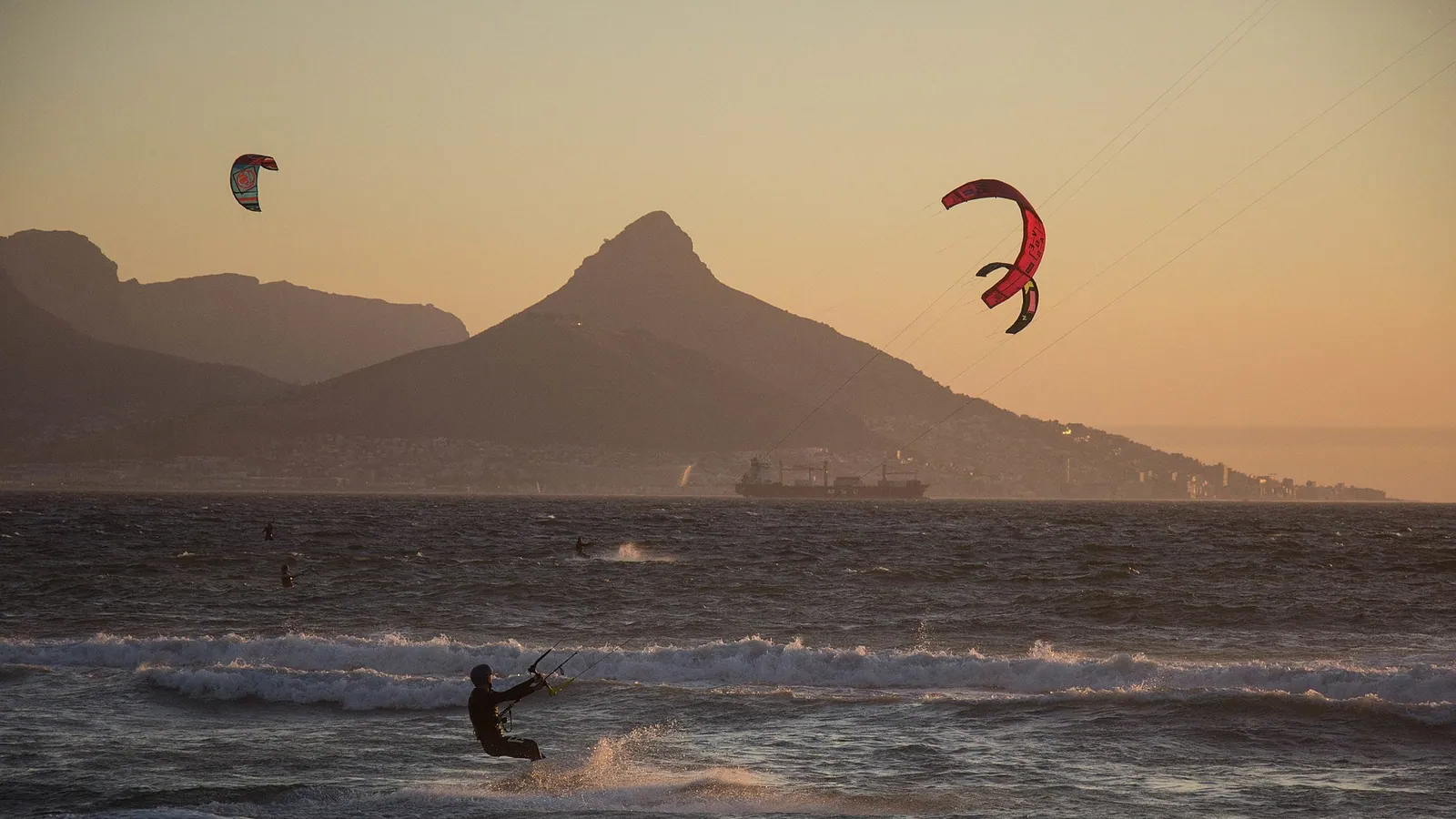
TL;DR: Cape Town is the strong-wind capital of kitesurfing: the summer Cape Doctor delivers 25–35-knot days from November to March at the Bloubergstrand beaches, with Table Mountain as the backdrop and the Red Bull King of the Air as the local proof. Bring small kites and a 4/3 wetsuit, learn at Langebaan (not the waves), and time your sessions off live readings — the Doctor keeps its own schedule.
Every sport has a Mecca. Kitesurfing in Cape Town is the version where the pilgrimage involves a 7 m kite, a wave board, water that bites, and an afternoon wind so reliable the city named it after a physician. From November to March, the Bloubergstrand strip is the most concentrated collection of high-level kiteboarding on Earth — and, with the right expectations, one of the best trips an intermediate can take.
Here’s the season by month, the spots that matter, and the local timing habit that saves your afternoons.
The Cape Doctor, explained
Summer in the South Atlantic parks a high-pressure system southwest of the country. Air squeezes anticlockwise around it, gets funnelled between the peninsula’s mountains and False Bay, and arrives at Table Bay as the south-easter — a dry, gusty-at-first, then locked-in trade wind the locals call the Cape Doctor (it “blows the sickness away,” along with anything not staked down).
Two behaviours define your trip:
- It cycles. The Doctor typically blows in multi-day runs — two to five days on, a rest day or two, repeat. Locals plan life around the cycle, not the calendar.
- It builds. Mornings often start light; the wind fills through midday and peaks mid-to-late afternoon, frequently ending 8–10 knots above the day’s forecast number.
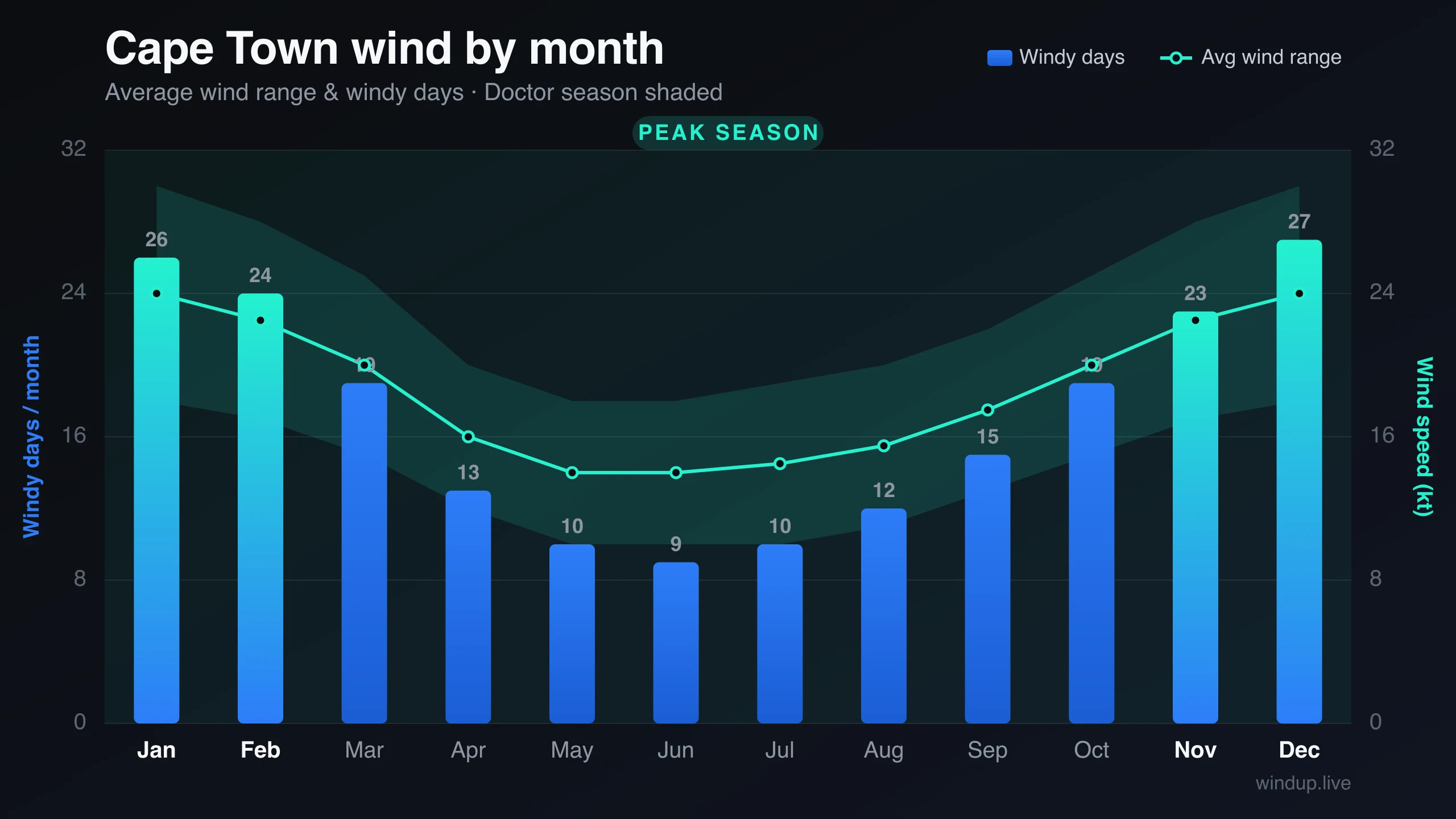
| Month | Avg wind (kt) | Windy days/month | Water temp | Notes |
|---|---|---|---|---|
| Nov | 17–28 | 23 | 15°C | Season opens; King of the Air window |
| Dec | 18–30 | 27 | 15°C | Peak — bring the 7 m |
| Jan | 18–30 | 26 | 16°C | Peak |
| Feb | 17–28 | 24 | 16°C | Peak, slightly gentler |
| Mar | 15–25 | 19 | 16°C | Tail of the season |
| Apr | 12–20 | 13 | 15°C | Shoulder; mixed systems |
| May | 10–18 | 10 | 14°C | Winter pattern starts |
| Jun | 10–18 | 9 | 14°C | NW fronts — storm riding only |
| Jul | 10–19 | 10 | 13°C | Deep winter |
| Aug | 11–20 | 12 | 13°C | Fronts, big swell |
| Sep | 13–22 | 15 | 14°C | First south-easters return |
| Oct | 15–25 | 19 | 14°C | Pre-season warm-up |
Winter (May–August) flips the pattern to north-westerly frontal storms — rideable for experienced storm chasers, but it’s not what you fly here for.
The spots
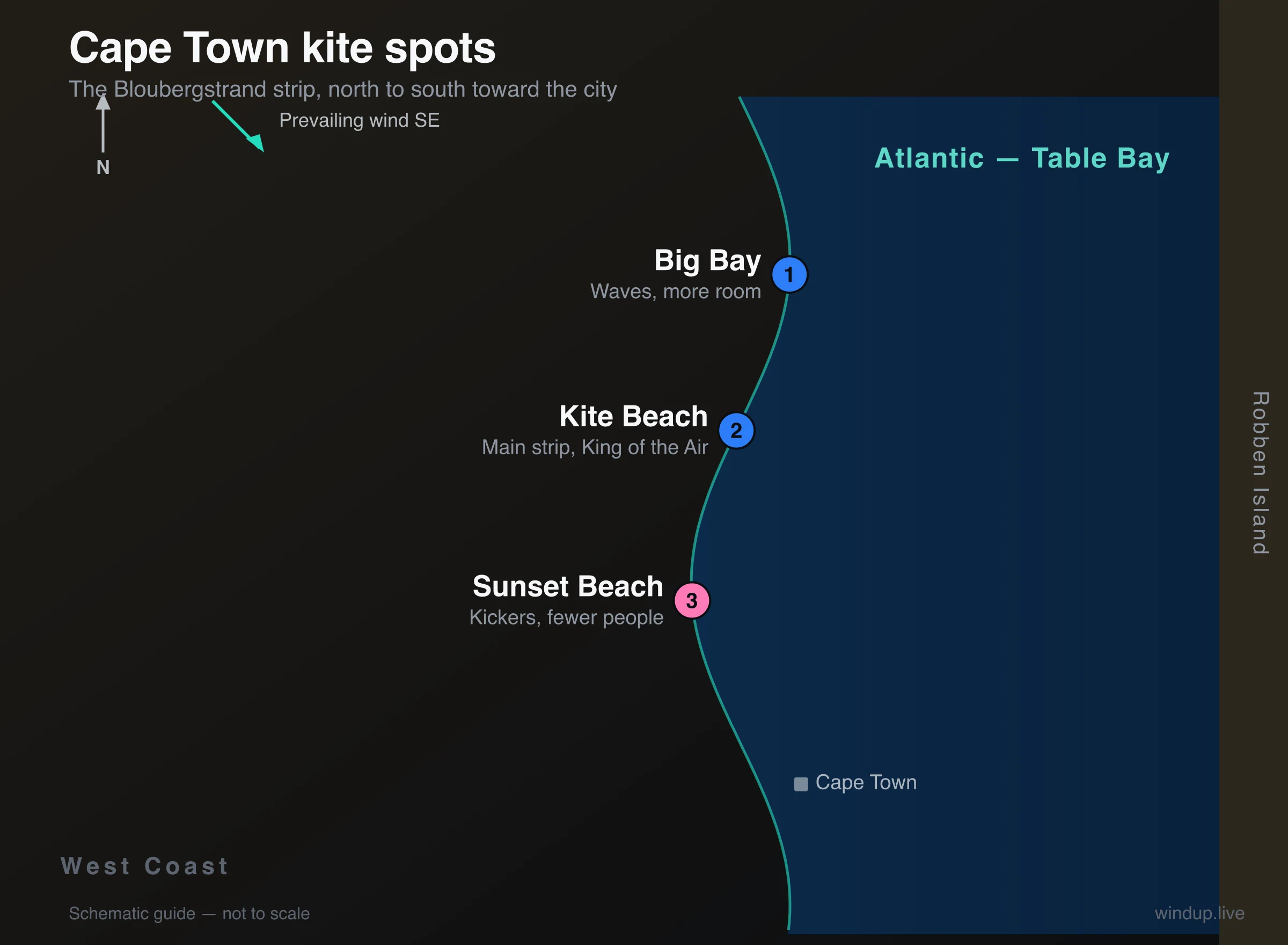
1. Kite Beach (Table View) — the main stage
The postcard: side-onshore Doctor, Atlantic ramps, and Table Mountain filling the horizon. Kite Beach is the dense heart of the scene — the launch is busy, the level is intimidating, and the vibe is world-championship-casual; this stretch hosts the Red Bull King of the Air. Waves are punchy but manageable kite-surf ramps rather than heavy reef. Respect the (very organised) launch etiquette and give the locals boosting to 20 metres their landing room.
2. Big Bay — waves and slightly more room
A few kilometres north, Big Bay adds proper wave faces and a touch more space to breathe. The southern corner is friendlier; the outside banks produce real down-the-line moments on the right swell. On big-cycle days it’s the better choice for riders who want to ride waves rather than dodge freestylers.
3. Sunset Beach — the kicker factory
Between Table View and the city, Sunset serves confident riders a meaner version of the same wind with fewer people and lumpier water. It’s where a lot of big-air training actually happens. Not a first-week spot.
The escape hatch: Langebaan
Ninety minutes north, the Langebaan lagoon is the anti-Blouberg: flat, shallower, warmer-feeling and typically 5–8 knots softer — the region’s proper learning and freestyle venue. If the Doctor is nuking 35 at Kite Beach, the lagoon is often a civilised 22. One caution: sections of the lagoon trend offshore-ish as the wind bends — stay in the designated riding zones and you’re fine. Beginners: start here, not in the waves; the difference in progression speed (and morale) is enormous.
What to ride (and wear)
Cape Town is where travel quivers go small: for an 80 kg rider the workhorse is a 7 m and a 9 m; heavier riders add an 8, lighter riders live on 6/8. Twin-tip big-air is the local religion, but a small wave board earns its bag space at Big Bay. Non-negotiable: a 4/3 wetsuit — 14°C water ends unprotected sessions in minutes, and the wind chill on a Doctor day is real. Translate the numbers to your own weight with the wind-by-weight guide, and if you think in Beaufort, a peak Doctor afternoon is a solid force 7.
Timing the Doctor
Here’s the local truth every visitor learns expensively: the forecast tells you the Doctor is coming; it does not tell you when. The build can run two hours early or three hours late, the peak can overshoot the model by 10 knots, and a “marginal 15-knot day” regularly becomes a 28-knot evening after everyone gave up and went wine tasting.
The fix is embarrassingly simple: watch the live Table Bay readings instead of refreshing models — or set a live wind alarm with your range (say 18–32 kt with a gust ceiling) and get rung the moment the strip switches on. WindUp’s alarm cuts through Do Not Disturb, which is exactly what you want when the Doctor shows up during your museum detour. Free download; the wine tasting can wait an hour.
Final word
Cape Town in season is the best strong-wind riding on the planet, full stop — and it’s a genuinely great trip even before you factor in the mountain, the food and the exchange rate. Come with small kites, honest self-assessment about the waves, and a live alarm doing the watching. For the opposite trip — warm, flat, mellow — our Egypt guides (El Gouna, Hurghada, Dahab) are the antidote, and Tarifa is the European middle ground.