


TL;DR: Tarifa is Europe’s #1 kite town because the Strait of Gibraltar funnels wind past it ~300 days a year. Two winds rule everything: Levante (strong, gusty, easterly, for experienced riders) and Poniente (cleaner, steadier, westerly, great for learning). Match the spot to the wind. Best season is April–October, peak July–August. Set a live alarm so you catch the Levante the moment it fills in instead of staring at the forecast.
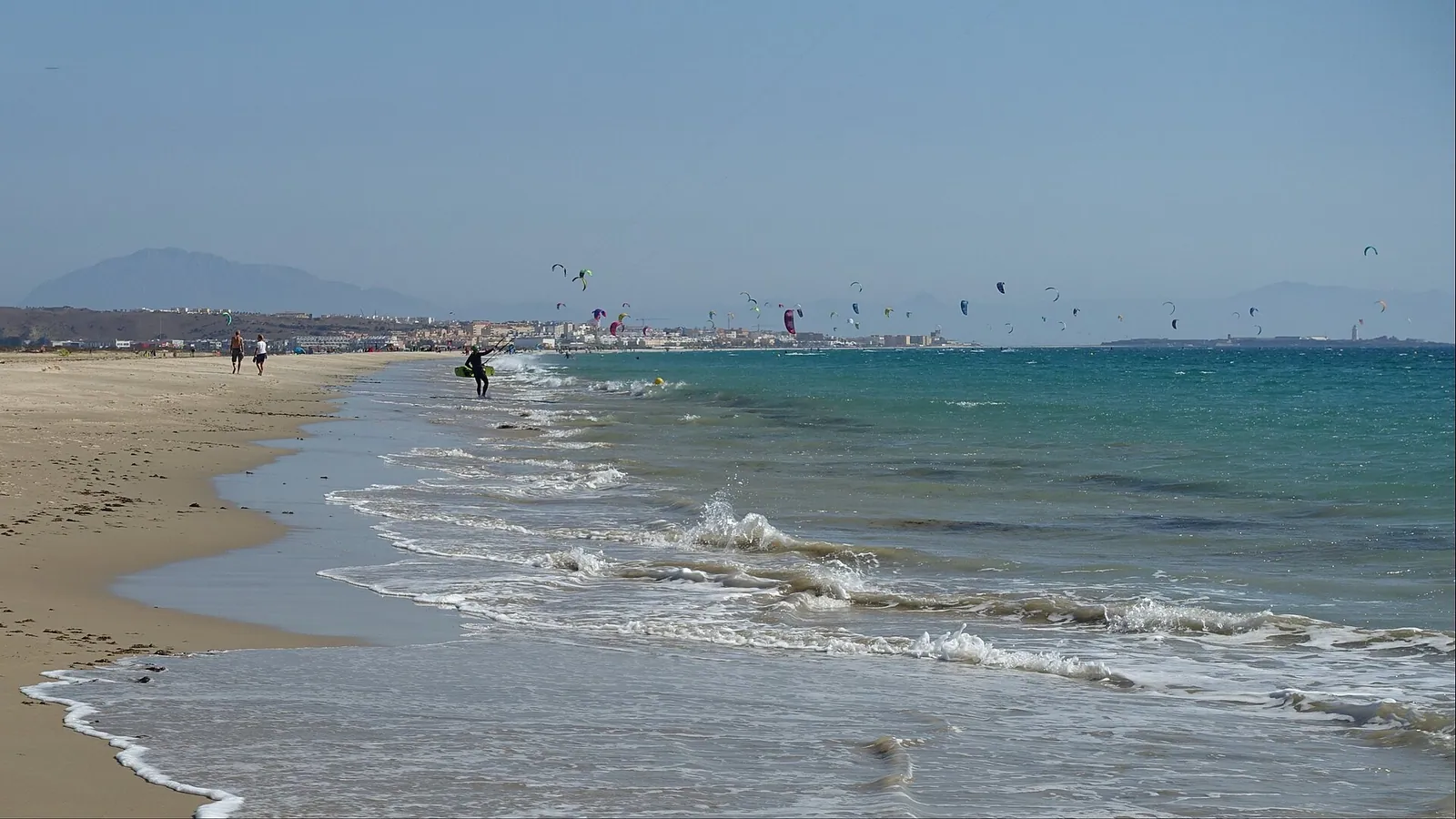
Tarifa is where European kitesurfing grew up. Stand on the beach at Los Lances on a July afternoon and you’ll see a few hundred kites in the air and hear five languages on the sand. Kitesurfing in Tarifa isn’t a gamble on the forecast the way most spots are. It’s a question of which wind is on today, and that single fact decides where you ride. Here’s the spot-by-spot breakdown, the two winds explained, the month-by-month stats, and the workflow that catches the Levante before it’s gone.
Why Tarifa gets so much wind
Tarifa sits at the narrowest point of the Strait of Gibraltar, where Europe and Africa nearly touch. Wind squeezing through that gap accelerates, the same way air speeds up through a funnel. The Strait of Gibraltar is only about 14 km wide at the narrows, and that pinch is the whole reason this town exists on the kite map.
Two pressure systems do the work. When high pressure sits over the western Mediterranean, you get Levante out of the east. When the Atlantic low takes over, you get Poniente out of the west. One or the other is usually blowing, which is why locals say Tarifa has “wind or more wind.” Calm days exist, they’re just rare in season.
The two winds: Levante vs Poniente
This is the one thing that separates Tarifa from a normal kite spot, so it gets its own section. Levante is the strong easterly. It’s gusty, it has a slightly offshore angle on the main town beaches, and it can blow 25–35 knots for days without a break. Pros love it. Beginners get humbled by it. Poniente is the westerly off the Atlantic, cleaner and steadier, blowing onshore, and it’s the wind that makes Tarifa learnable.
Most destination guides list Tarifa’s spots and stop there. But the spot you should ride changes completely depending on which wind is on, and nobody hands you that table. So here it is — the part that actually saves your session.
| Spot | On Levante (E) | On Poniente (W) | Best for |
|---|---|---|---|
| Los Lances (south) | Gusty, offshore-lean, busy | Clean, onshore, steady | Poniente days, all levels |
| Valdevaqueros | Strong, more side-on, the Levante spot | Onshore but quieter | Levante days, intermediates+ |
| Balneario | Punchy, town-side, crowded | Onshore and forgiving | Quick sessions, schools |
| Punta Paloma | Cleaner Levante, big space | Side-on, mellow | Levante, more room |
The takeaway: when the forecast says Levante, drive to Valdevaqueros or Punta Paloma where the angle is more side-on and safer. When it says Poniente, Los Lances and Balneario turn into beginner-friendly playgrounds. Get this wrong and you’ll either be overpowered and offshore, or sitting on the sand watching everyone else.
The best kitesurfing spots in Tarifa
Tarifa’s spots all sit along one long Atlantic-facing arc north-west of town. They’re close together, so you can chase the wind between them in 15 minutes by car. Here’s how they rank.
1. Los Lances — the main beach
The wide sandy beach right next to town, and the one most people picture when they think Tarifa. On Poniente it’s a dream: clean onshore wind, soft sand, shallow near shore, room for hundreds of riders. On Levante it turns gusty with an offshore lean, so the south end gets sketchy for beginners. Huge, central, and the social heart of the scene.
- Level: Beginner → Advanced (on Poniente)
- Best wind: Poniente (W), onshore
- Bottom: Sand
- Vibe: Busy, international, schools everywhere
2. Valdevaqueros — the Levante spot
About 10 km up the coast, framed by a giant sand dune. This is the spot to ride when Levante is honking. The angle here is more side-on than in town, which makes the strong easterly far safer and a lot more fun. It gets crowded on classic Levante days because everyone knows the same thing. Flatter near shore, chop and small swell further out.
- Level: Intermediate → Advanced
- Best wind: Levante (E), side-on
- Bottom: Sand
- Vibe: The pro and progression crowd
3. Balneario — the town launch
The closest launch to Tarifa itself, right by the old town. Convenient for a quick after-work session and home to several schools because it’s so accessible. It’s tighter and busier than the open beaches, and the wind is punchier on Levante because of the town buildings upwind. Best treated as a Poniente or quick-hit spot rather than your main beach.
- Level: Beginner → Intermediate
- Best wind: Poniente (W)
- Bottom: Sand
- Vibe: Walkable, school-heavy, convenient
4. Punta Paloma — the space option
Further north past Valdevaqueros, near the famous white dune. More room, fewer kites, and the Levante tends to clean up a little by the time it reaches here. A good call when Valdevaqueros is packed and you want elbow room. The walk from the car is longer, which is exactly why it’s quieter.
- Level: Intermediate → Advanced
- Best wind: Levante (E), cleaner here
- Bottom: Sand
- Vibe: Open, calmer, scenic

Tarifa wind stats by month
Tarifa blows roughly 300 days a year thanks to the Strait, but the kind of wind shifts with the season. Summer brings the long, strong Levante runs. Spring and autumn lean more toward Poniente and lighter, friendlier days. Water is Atlantic-cool year-round, so a wetsuit is part of the kit even in August.
| Month | Avg wind (kt) | Windy days/month | Water temp | Dominant wind |
|---|---|---|---|---|
| Jan | 12–22 | 16 | 16°C | Mixed |
| Feb | 13–22 | 16 | 15°C | Mixed |
| Mar | 14–24 | 18 | 16°C | Poniente-lean |
| Apr | 15–25 | 20 | 16°C | Poniente-lean |
| May | 15–26 | 22 | 17°C | Mixed, friendly |
| Jun | 16–28 | 24 | 19°C | Mixed |
| Jul | 18–32 | 27 | 20°C | Levante peak |
| Aug | 18–32 | 27 | 21°C | Levante peak |
| Sep | 16–28 | 23 | 21°C | Mixed, quieter |
| Oct | 15–25 | 20 | 20°C | Poniente-lean |
| Nov | 13–22 | 16 | 18°C | Mixed |
| Dec | 12–22 | 15 | 17°C | Mixed |
Read it like this: if you want the most days on the water, come in July or August and accept strong Levante. If you want steadier, more learner-friendly wind and fewer crowds, target late May, June or September. The wind doesn’t vanish in shoulder season, it just calms down a notch.

What kite sizes to bring to Tarifa
Tarifa is a high-wind destination, so most riders rig smaller than they’d expect. On a strong July Levante you might be on a 7 m all afternoon, and the riders flying 12 m kites in town are the ones who didn’t check the forecast. Pack for range, not for one perfect day.
- Kites: A 7 m and a 9 m cover most strong-wind days. Add a 12 m for lighter Poniente afternoons and shoulder season. Many summer riders never rig above 9 m.
- Board: A 135–140 twin-tip is ideal. The chop on Levante days rewards a slightly bigger board than glassy lagoons would.
- Wetsuit: This is the Atlantic. A 3/2 mm full suit in summer, a 4/3 mm in spring and autumn. Tarifa is not the warm Red Sea.
- Helmet and impact vest: Genuinely sensible here. Crowded beaches plus gusty Levante means more close passes than you’re used to.
- Harness leash and a fixed plan to depower: Levante gusts come in hard. Know how to dump power before you need to.
Not sure where your personal wind range sits? Our guide to how much wind you need to kitesurf breaks down kite size by rider weight so you can pack the right quiver.
Schools and lessons
Tarifa has one of the highest concentrations of kite schools in the world, which is part of why it became the learning capital of Europe. Most are clustered around Los Lances and Balneario, and many run radio-helmet lessons on the wide beaches. The smart move for beginners: book lessons on Poniente days. A good school will reschedule you off a wild Levante rather than send you out overpowered.
A few honest pointers. Lessons are pricier here than in Egypt or the Canaries because Tarifa is a premium European destination. Group lessons are cheaper but you’ll spend time waiting your turn on the bar. And no school can conjure the right wind, so a flexible booking that lets you move days when Levante is howling is worth more than the lowest price.
If you’ve kited the Red Sea, the contrast is sharp: warmer, flatter and steadier there, stronger and gustier here. Our Hurghada kitesurfing guide is a good companion read if you’re deciding between an easy-mode trip and a Tarifa progression trip.
How not to miss a Levante session
The Levante is the wind that makes or breaks a Tarifa trip, and it has a habit of filling in fast and unpredictably. You can wake up to a flat sea and be massively powered by lunch. The classic Tarifa mistake is the same one riders make everywhere: refresh Windy, refresh Windguru, drive down, and find you’ve already missed the best two hours.
Three things keep you on the water instead of on the forecast app:
- Compare two forecast models the night before. When ECMWF and GFS agree on a Levante, the next-day call is close to certain. When they disagree by 5+ knots, it’s a coin flip, don’t commit your morning.
- Set a live alarm at the spot you’ll ride. A forecast says “tomorrow looks windy.” A live wind station says “it’s on, right now.” For a wind that fills in as fast as the Levante, that difference is the whole session.
- Filter by direction. Levante and Poniente send you to different beaches. Only get pinged when the wind is the direction that suits your spot and your level, so a strong offshore-lean Levante doesn’t drag you out to a sketchy launch.
WindUp is built for exactly this. Pick the station closest to Los Lances or Valdevaqueros, set your wind range (say 15–28 kt) and the direction you want, and your phone rings the moment it’s on. Even on Do Not Disturb. Free alarm, no subscription. See the kitesurfing setup guide for the exact min, max and direction config, then download WindUp before your trip and dial it in on the first windy morning.
Tarifa season at a glance
If you’re booking a trip and want a one-line answer:
- Best time to go: July and August for maximum wind and the full scene.
- Best for learning: late May, June and September, when Poniente is more common and the beaches are calmer.
- Quietest with good wind: April and October, cooler water but real conditions.
- Hardest months: deep winter is rideable but a gamble, with cold Atlantic water and mixed wind.
Tarifa rewards riders who plan around the wind direction instead of just the wind strength. Get the Levante-versus-Poniente call right, drive to the matching beach, and you’ll understand why this small Spanish town became the heart of European kitesurfing.
FAQ
The thing to take away: in Tarifa you read the wind direction before you pick the spot. Levante or Poniente first, then the beach that suits it, then the kite. Get that order right and the gusty Mecca of European kitesurfing finally makes sense.
Chasing the southern summer instead? Cape Town in Doctor season is the strong-wind pilgrimage, and Cabarete is the warm-water antidote.