


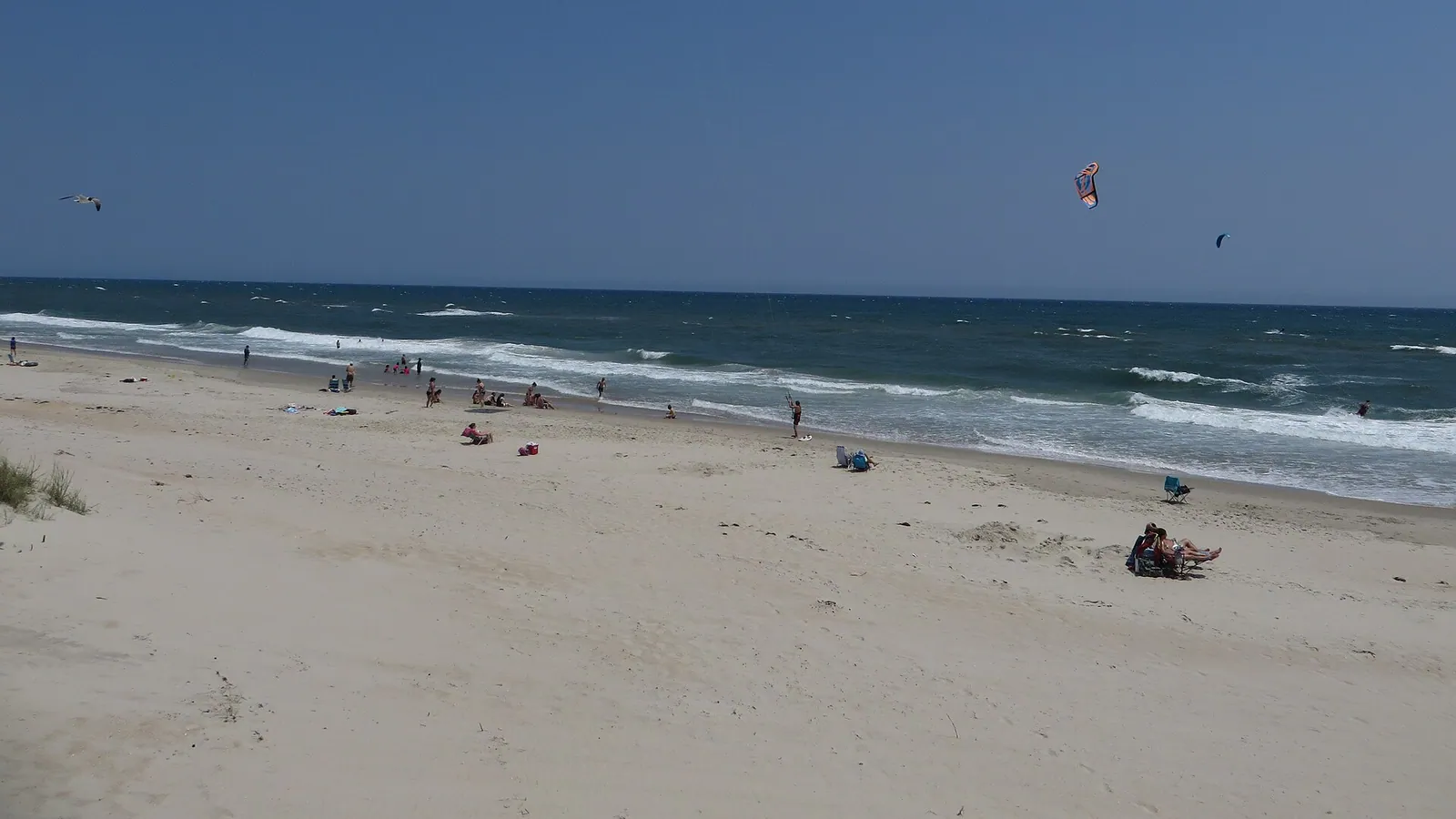
Short answer: Most kitesurfers need about 15–25 knots to get going and stay upwind on a typical 9–12 m kite. Lighter riders, bigger kites and foilboards drop the minimum to 12 kt or below. The honest answer isn’t a single number — it’s a function of your weight, your kite size and your skill. Here’s the table, plus why direction and gusts matter as much as the average.
“How much wind to kitesurf” sounds like it should have one answer. It doesn’t, because the same 14 knots that overpowers a 90 kg rider on a 12 m kite barely lifts a 60 kg rider on a 9 m. What actually decides whether it’s on is the relationship between three things: how much you weigh, how big your kite is, and how confident you are. Here’s how those line up.
What’s the minimum wind for kitesurfing?
The practical minimum for most riders is 12–15 knots on a big kite, dropping to 8–10 kt on a hydrofoil. Below that, a twin-tip rider can’t generate enough power to stay upwind and ends up walking back along the beach. Foilboards change the maths because they need far less power to lift.
The minimum isn’t fixed because it scales with your gear and body. A light rider on a 14 m kite is riding while a heavy rider on a 9 m is standing on the sand watching. That’s not a skill gap — it’s physics. More body weight needs more pull to support it, and more kite area generates more pull at the same wind speed.
So when someone says “you need 15 knots to kite,” they’re describing an average 75–80 kg rider on a mid-size kite. Adjust from there.
How much wind by rider weight and kite size?
Shortcut: punch your weight and today’s wind into the free kite size calculator and it runs this section’s math for you — including surfboard and hydrofoil modes.
For an average rider, 15–22 knots is the all-around sweet spot, matching Force 4–5 on the Beaufort scale (11–21 kt). This table maps body weight and kite size to a realistic wind range. It assumes a twin-tip and an intermediate who can stay upwind — beginners and foilers sit outside it, which we cover below.
| Rider weight | Kite size | Minimum wind | Sweet spot | Getting strong |
|---|---|---|---|---|
| 55–65 kg | 12 m | 12 kt | 14–20 kt | 24+ kt |
| 55–65 kg | 9 m | 16 kt | 18–25 kt | 30+ kt |
| 70–80 kg | 12 m | 14 kt | 16–22 kt | 26+ kt |
| 70–80 kg | 9 m | 18 kt | 20–27 kt | 32+ kt |
| 85–95 kg | 14 m | 14 kt | 16–22 kt | 26+ kt |
| 85–95 kg | 11 m | 18 kt | 20–26 kt | 30+ kt |
| 85–95 kg | 9 m | 22 kt | 24–30 kt | 34+ kt |
The pattern we see again and again at busy beaches: two riders call the same day completely differently. A 62 kg rider on a 12 m is lit and grinning at 16 kt; their 90 kg mate on the same kite is barely planing. Read the wind through your weight and your quiver, not the forecast number in isolation.
What’s the best wind for kitesurfing?
For most recreational riders the sweet spot is 18–22 knots — enough to ride powered, jump a little, and not feel like you’re fighting the kite. This is the band where a 9–12 m kite sits in its happy range for a 70–80 kg rider, and where staying upwind stops being a chore.
Above that, the fun continues but the gear shrinks. At 25 kt you’re on a smaller kite, riding faster and harder. At 30 kt+ you’re in expert territory on a 5–7 m, and the margin for error narrows fast. Below 15 kt the day tips toward foil boards or sitting it out.
The “best” wind is really the wind that matches the kite on your bar. Pick the kite first, then the wind range follows.
Beginner vs advanced: how the minimums differ
Beginners want a steady 12–18 knots, not the lightest possible wind. Too little and the kite won’t fly cleanly through the window; too much and a learner gets dragged. Steady is the operative word — gusty 12–25 kt is far harder to learn in than a constant 16 kt, even though the average looks tame.
Most guides tell beginners to seek “light wind,” which is misleading. A glassy 10 kt is actually harder for a learner than a clean 16 kt, because an underpowered kite stalls, backstalls and drops out of the sky. Beginners need enough steady power to keep the kite responsive, with an instructor sizing the kite down so the rider isn’t overpowered. Steady beats light.
Advanced riders flip it. They’ll ride almost anything with the right kite, foil through 9 kt thermals, and treat a 30 kt day as a small-kite session. Their minimum is set by gear and nerve, not by the wind.
Stop refreshing the forecast. Set your weight-and-kite wind range as a live alarm at your local station, add a gust ceiling and a direction filter, and let your phone tell you when it’s on. Get WindUp — the alarm is free — it rings even on Do Not Disturb and watches 10,000+ live wind stations.
Why direction matters as much as wind speed
A 20 kt cross-onshore wind is the safest, most rideable direction: it pushes a tired or unhooked rider back toward the beach. The same 20 kt blowing straight offshore is genuinely dangerous — equipment fails, your arm gives out, and the wind is carrying you out to sea with no easy way back.
Onshore wind is safe for self-rescue but can pin you against the beach, making launches and landings messy. Cross-shore is fast and clean. Cross-onshore is the gold standard most schools teach in. So before you fixate on whether it’s 18 or 22 kt, ask which way it’s pointing. A perfect-speed offshore day is a no-go for most riders without boat support.
If your spot is offshore-prone, filter for direction in your alarm so a great-looking number never lures you out on the wrong wind.
Gusts decide whether you rig up or sit down
The average wind tells you if it’s worth going; the gust tells you what kite to pump. A spot reading 18 kt average with 30 kt gusts is not an 18 kt day — it’s a rig-for-the-gusts day, and you size down. As a working rule, if gusts run 8+ knots over the average, drop a kite size and expect to be busy on the bar.
Gusty wind is also where lofting accidents happen — a sudden 30 kt punch into a 12 m kite can lift a rider off the ground. Steady wind forgives mistakes; gusty wind punishes them. This is why we trust the live gust reading over the forecast average every time. The forecast smooths gusts out; the station shows them as they hit.
Catch the window instead of missing it
Coastal and thermal wind builds and fades on its own clock, often peaking for a two- or three-hour window that you’ll miss completely if you check the forecast at the wrong moment. Forecasts get you close, but they are a prediction, not the live reading — the wind at your spot can run several knots off the app, which is exactly why we tested forecast accuracy against live stations. The fix is to stop refreshing and let the live wind tell you when your window opens.
The workflow that actually works:
- The night before: compare two forecast models. When they agree on a kiteable range for your weight and kite, pencil it in.
- The morning of: stop trusting the forecast. Watch the live station reading at your launch.
- Set a live alarm with your min/max wind, a gust ceiling and a direction filter, then put the phone down until it rings.
That’s exactly what WindUp is built for. See the kitesurfing setup page for recommended thresholds, the best wind app for kitesurfing comparison if you’re choosing tools, or our Dahab kitesurfing guide for a spot where the thermal locks in almost daily.
What wind do you want?
“How much wind to kitesurf” has no universal answer — it’s set by your weight, your biggest and smallest kites, your board type and your skill. The table above is a starting point; your own session log is the real guide. Note the wind at the moments you had the best rides, and that band becomes your personal sweet spot.
The meta-rule is the same for everyone: stop guessing, start measuring. Pick your range, rig for the gusts, check the direction, and ride when it’s actually on — not when the forecast hopes it might be.
FAQ
Common questions about kitesurfing wind speed, answered above and below. The honest take: there’s no single magic number. Work out your minimum and sweet spot for your weight and kite, set a live alarm for it, and quit refreshing the forecast.