


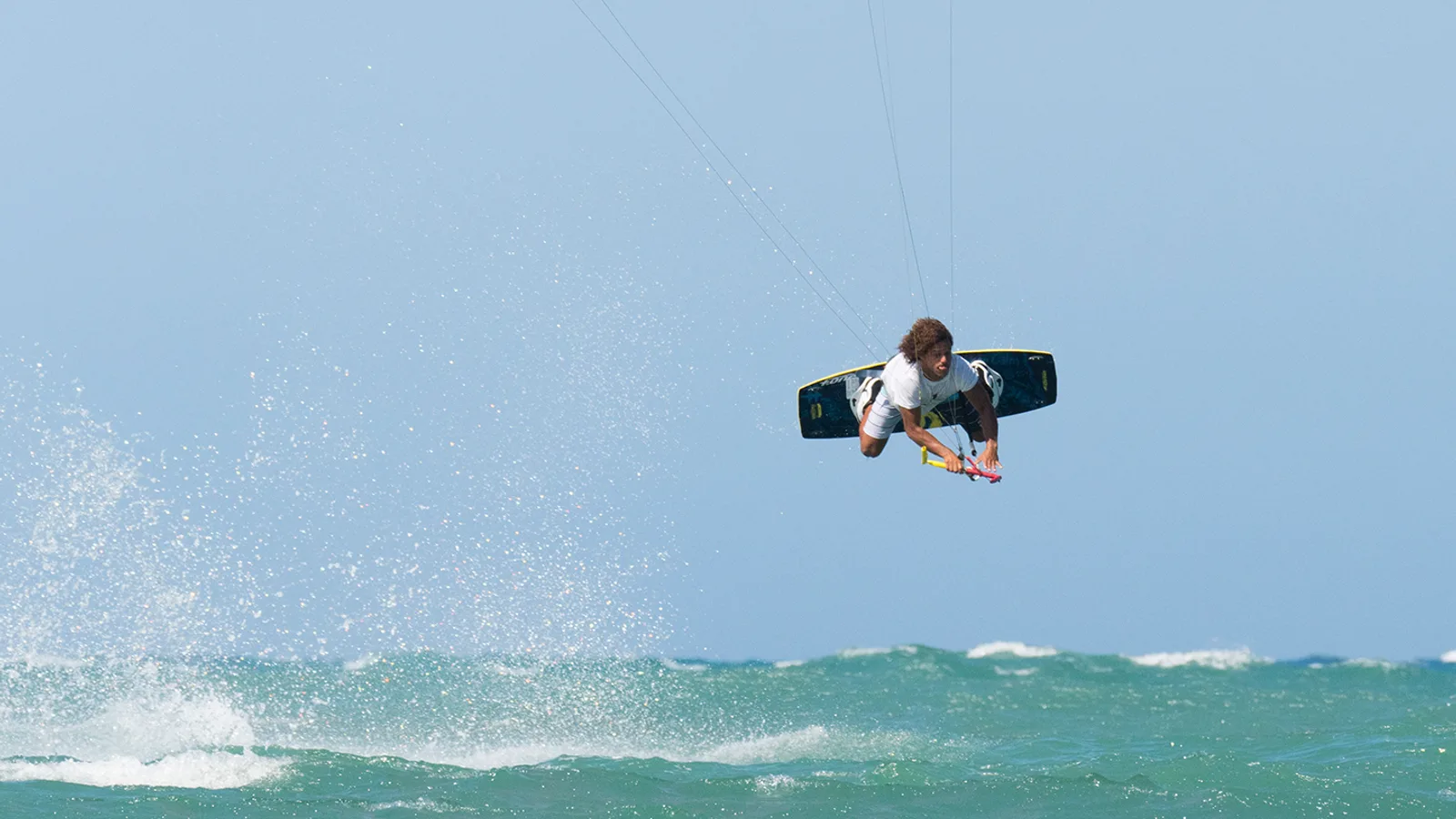
TL;DR: Cabarete runs on a daily thermal schedule: calm mornings, then the trades-plus-sea-breeze switch the bay on around midday, peaking 15–25 kt mid-afternoon. Peak months June–August, a second season December–March, boardshorts water all year. Kite Beach is the main stage, Bozo is the roomy learner end, La Boca is the flat-water playground. Surf in the morning, kite after lunch — that’s the whole town.
Some destinations sell wind statistics. Kitesurfing in Cabarete sells a rhythm: wake up, surf or laze through a glassy Caribbean morning, watch the palms start to move at lunch, and be powered on a 9 m by three. The Dominican Republic’s north coast has run on that clock for thirty years — it’s arguably where the kite-town lifestyle was invented — and it remains the easiest warm-water trip in the sport.
Here’s how the wind actually works, the spots, and the one habit that beats the thermal’s loose schedule.
Why the afternoon, every afternoon
Cabarete’s engine is a stack of two winds. The base layer is the Caribbean trade wind out of the east — steady but often too light on its own. The multiplier is the island thermal: as the Dominican interior heats through the morning, rising air pulls the sea breeze onshore, and from roughly midday the two add up. Side-onshore, warm, and repeatable — the bay’s reef line keeps the inside manageable while the outside gets proper chop-hop ramps.
The catch: the timing floats. Cloud over the mountains delays it; a hot clear morning brings it early; some days the stack tops out at 14 knots and the big kites win. Locals don’t argue with it — they watch for it.
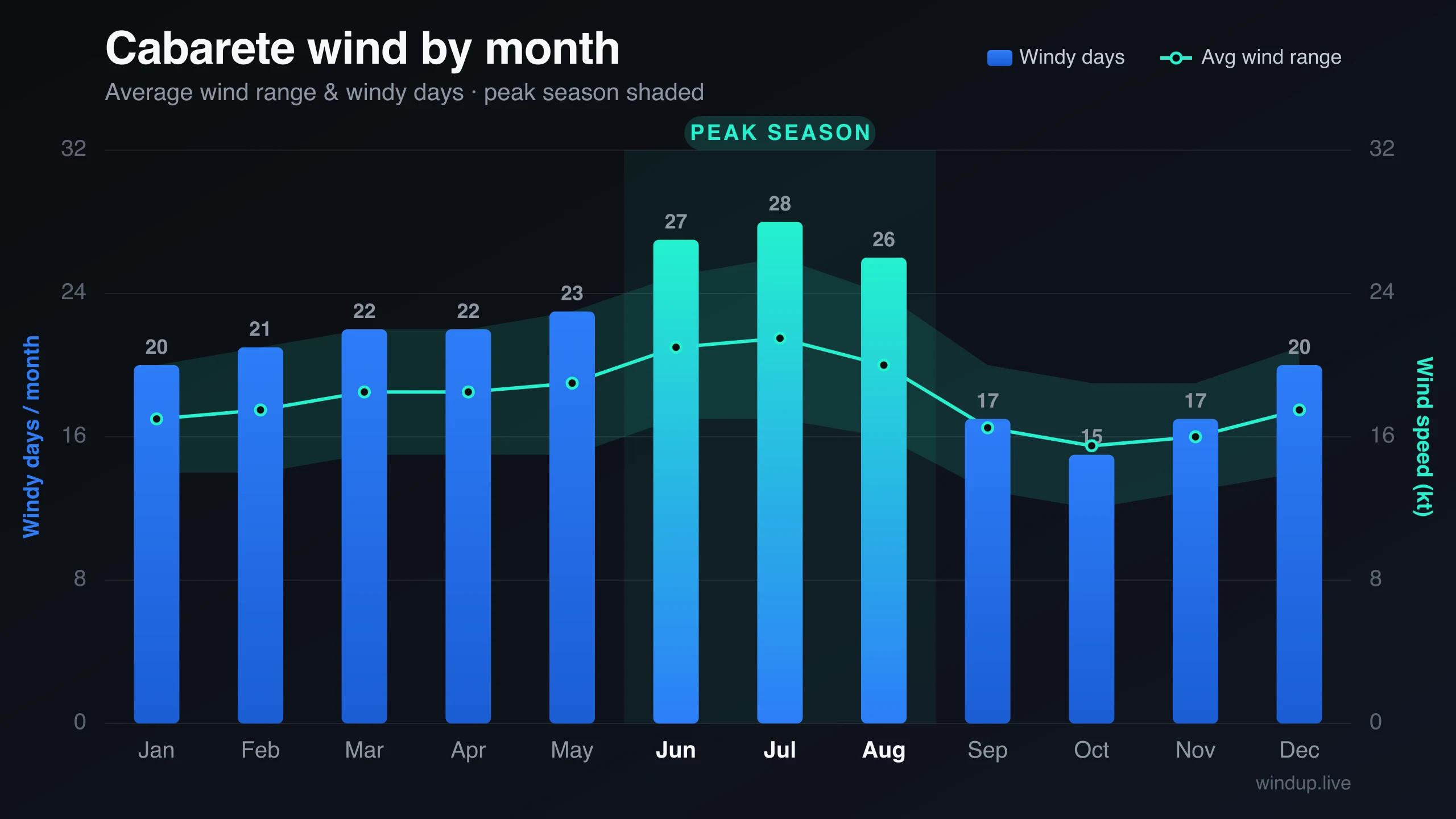
| Month | Avg wind (kt) | Windy days/month | Water temp | Notes |
|---|---|---|---|---|
| Jan | 14–20 | 20 | 26°C | Winter trades, steady |
| Feb | 14–21 | 21 | 26°C | Reliable second season |
| Mar | 15–22 | 22 | 26°C | Strong late-winter form |
| Apr | 15–22 | 22 | 27°C | Transition, still good |
| May | 15–23 | 23 | 27°C | Building to summer |
| Jun | 17–25 | 27 | 28°C | Peak begins |
| Jul | 17–26 | 28 | 28°C | Peak — strongest thermals |
| Aug | 16–24 | 26 | 29°C | Peak, warmest water |
| Sep | 13–20 | 17 | 29°C | Lightest; hurricane-season wildcard |
| Oct | 12–19 | 15 | 28°C | Low season |
| Nov | 13–19 | 17 | 27°C | Trades return |
| Dec | 14–21 | 20 | 27°C | Season restart |
September and October are the honest asterisk: the lightest months, with tropical-system roulette deciding whole weeks. If your dates are fixed to early autumn, hedge with a foil.
The spots
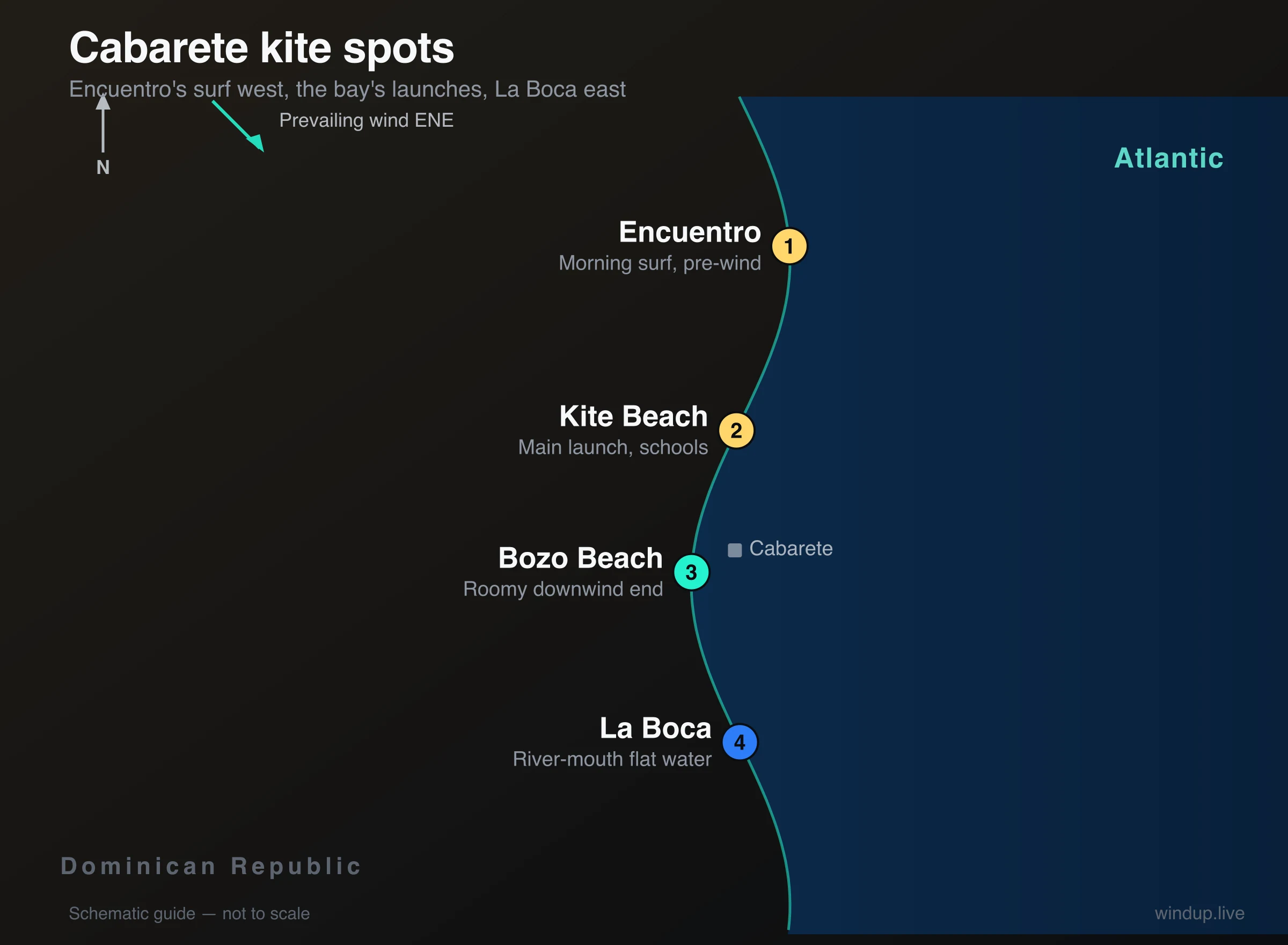
1. Kite Beach — the main stage
The western end of Cabarete Bay is the sport’s town square: schools, rescue boats, gear shops and a launch that fills with every level by 1 p.m. Inside the reef line it’s manageable chop; outside, the trade swell builds ramps that made this bay a freestyle factory. Peak-season afternoons get genuinely busy — launch with patience and ride upwind for space.
2. Bozo Beach — the roomy downwind end
Down the bay toward town, Bozo trades polish for space: a wider beach, softer inside water, and the natural catchment for anyone drifting downwind (hence the affectionate name). It’s where a lot of first water-starts happen. Watch the shore-dump on bigger swell days when landing gear.
3. La Boca — the flat-water classroom
Fifteen minutes east, the Yásica river mouth opens into a ribbon of butter-flat, waist-to-chest-deep water with the same afternoon wind and none of the swell. It’s the progression and freestyle spot — first jumps, first unhooked tricks, first clean transitions all cost less here. Small launch, local operators shuttle riders in; go with someone who knows the etiquette.
The bonus: Encuentro (mornings, no kite)
Four kilometres west, Playa Encuentro is the surf break — and the reason Cabarete mornings don’t feel like waiting. Glassy dawn sessions there, kites in the bay after lunch: two sports on one daily schedule. (If you’re new to reading morning wind for surf, our surfing wind guide explains the glass window.)
What to ride
Warm, moderate, thermal wind means normal-to-big kites: a 9 m + 12 m covers most 80 kg riders across the year, with the 12 doing the heavy lifting outside June–August. Twin-tip first; a surfboard earns its place on outside-swell days; a foil turns the shoulder months into a real season. Calibrate to your weight with the wind-by-weight table, and keep the knots conversions handy — Cabarete forecasts get quoted in everything.
Beating the thermal’s schedule
The Cabarete mistake is treating “wind from 1 p.m.” as a promise instead of an average. The thermal’s switch-on drifts by two hours either way, and the difference between a 90-minute session and a four-hour one is usually when you noticed.
So do what the beach bars do, without the bar tab: watch the live reading, not the clock. Set a live wind alarm for your range — say 15–24 kt — and let it ring you off Encuentro’s lineup or out of the hammock the moment the bay switches on. WindUp is free and cuts through Do Not Disturb; the thermal doesn’t send a calendar invite.
Final word
Cabarete isn’t the windiest place in this series — Cape Town takes that crown — and it isn’t the flattest (El Gouna wins there). What it offers is the best daily life in kitesurfing: warm water, a wind you can set your afternoon by, surf before lunch and a town built entirely around both. For a first kite trip or a no-wetsuit winter escape, it’s still the benchmark.