


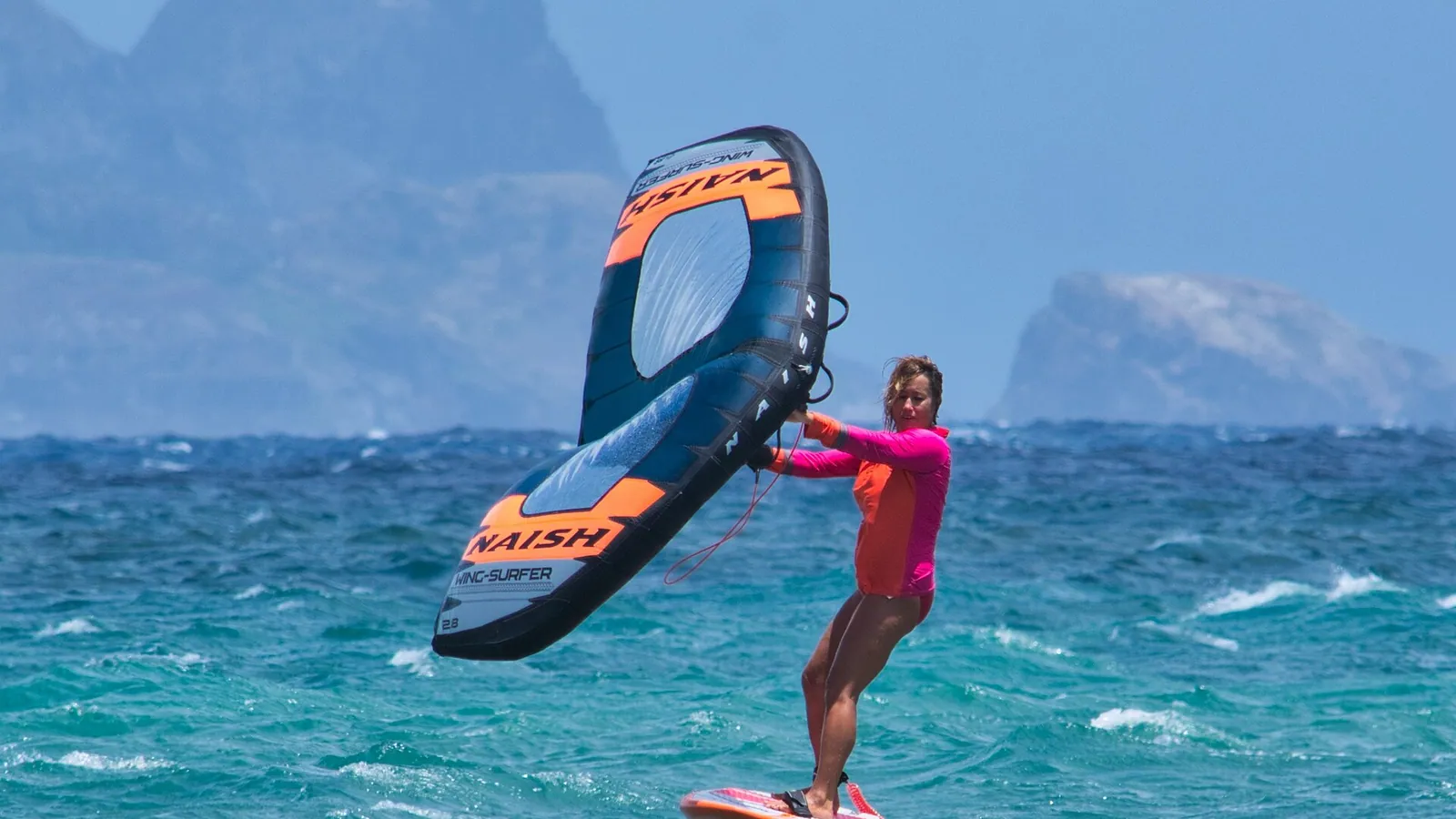
Short answer: Most wing foilers need around 12-22 knots, with 14-20 kt the comfortable sweet spot for an average rider. Lighter riders foil from about 10 kt; heavier riders want the top of the band. The band is narrower than windsurfing because a foil generates lift over a tighter speed range, and steady wind matters more than the peak number.
Wing foiling has one of the tightest wind windows of any board sport. Too light and you can’t get up onto the foil; too much and a single wing is hard to handle through the gusts. The good news: once you’re foiling, you stay up on far less wind than it took to launch. That changes how you should read a forecast. Here’s the breakdown by wing size, foil size and rider weight, plus why stable wind beats a big average.
Quick reference: wing size, foil size and rider weight
Want it computed for your exact weight and today’s wind? The free wing size calculator runs this chart’s rule of thumb live.
| Rider weight | Wind range | Wing size | Foil size | Notes |
|---|---|---|---|---|
| ~65 kg (light) | 10-16 kt | 5.0-6.0 m | 1500-2000 cm² | Gets up early; size down above 18 kt |
| ~65 kg | 16-22 kt | 4.0-4.5 m | 1200-1500 cm² | Powered freeride |
| ~80 kg (average) | 12-18 kt | 5.0-6.0 m | 1500-1800 cm² | The everyday setup |
| ~80 kg | 18-24 kt | 4.0-4.5 m | 1100-1400 cm² | Fully lit, fun |
| ~95 kg (heavy) | 14-20 kt | 6.0-7.0 m | 1800-2200 cm² | Needs more to get up |
| ~95 kg | 20-26 kt | 4.5-5.0 m | 1400-1600 cm² | Powered, watch the gusts |
These are general ranges for a planing/foiling freeride session. Your exact numbers shift with foil efficiency, board volume and skill. A high-aspect foil flies on noticeably less wind than a beginner’s big low-aspect wing.
What’s the real minimum wind for wing foiling?
For most riders the practical floor is around 12 knots. That’s enough to load a 5-6 m wing, build board speed and pop onto the foil. Below 12 kt you can still drill water starts, flagging and balance, but you’ll struggle to sustain flight. Light riders on a big wing and a high-volume board sneak it down to about 10 kt; heavier riders often want 14 kt before it’s worth rigging.
The honest part: the minimum to get up is higher than the minimum to stay up. Once you’re foiling, you keep flying on surprisingly little. That’s why a steady breeze that sits just above your launch threshold can give a full session, while a higher but gusty average keeps dropping you off the foil.
Why is the wing foiling wind band so narrow?
Two reasons. First, a hydrofoil produces usable lift across a tighter speed range than a fin and hull, so the gap between “won’t fly” and “flying nicely” is small. Second, you usually carry one wing, not a windsurfer’s quiver of sails. You can sheet out and depower a wing, but only so far. When a windsurfer would swap a 7.5 m for a 4.7, you’re stuck managing the same wing through everything the wind throws at you.
That’s why we treat 14-20 kt as the comfort zone for an average rider. Step much outside it and either the wing or the foil becomes the limiting factor. Compare that to windsurfing, where pros plane from Force 4 all the way to Force 7 (roughly 11 to 33 knots on NOAA’s Beaufort scale) by changing kit, and you can see why wing foiling feels fussier.
Stable wind matters more than a big number
This is the part most beginners learn the hard way. A steady 14 knots usually beats a gusty 18 kt average. On the foil you ride through lulls easily, but a sudden drop pulls you off the foil, and now you have to restart in whatever marginal power is left. Then the gust hits while you’re powering up and you’re overpowered before you’re even flying.
So read the spread, not just the average. If gusts are running 8-10 knots over the mean, expect a stop-start session and size your wing for the gusts, not the lulls. A clean, consistent reading at your launch is worth more than a punchy forecast.
Want the moment your spot hits a steady band? Set a live wind alarm on WindUp with your min, max, gust ceiling and direction. The alarm’s free, works on iOS and Android, and rings through Do Not Disturb the second your window opens.
How direction and gusts change the call
Direction matters as much for wing foilers as for any board sport. A cross-onshore breeze brings you back to the beach if you go down; a straight offshore wind blows you out to sea, and a wing is slow to self-rescue with. Always check direction before you commit, and filter for it if your launch is offshore-prone.
Gusts decide your wing size. A spot reading 16 kt average with 28 kt gusts is not a 16 kt day, it’s a rig-small day. The danger in wing foiling isn’t the mean wind, it’s getting caught powered up on the wrong wing when a gust lands. As a rule, size for the gust and sheet out in the lulls.
How to catch the window instead of missing it
Coastal wind builds and fades on its own schedule, often peaking for a short thermal window. The workflow that works for us:
- Night before: compare two forecast models. When they agree on a steady band in your range, plan it.
- Morning of: stop trusting the forecast and watch the live station nearest your launch.
- Set a live alarm with your min/max, a gust ceiling and a direction filter, then put the phone down.
That’s what we built WindUp for: live readings from 10,000+ wind stations and a per-sport alarm that rings even on silent. See the recommended thresholds on the wing foiling setup page, and if you want to translate forces to knots, the Beaufort scale to knots chart lines up wing foiling at roughly Force 4-5.
So how much wind do you actually want?
There’s no universal “best wind for wing foiling” number, but the band is real: most riders foil happily in 12-22 knots, with 14-20 kt the everyday sweet spot. Your own figure depends on weight, wing size, foil efficiency and skill, so build your logbook and learn your personal floor.
The meta-rule beats any chart: chase steady wind, size for the gusts, and measure your spot instead of guessing. Set an alarm for your band and ride when it’s genuinely on.
FAQ
Common wing foiling wind questions answered above and below. The short version: learn your get-up threshold, remember you stay up on far less, and prize a steady breeze over a big gusty average.